
Decision area · Supplier evidence
Turn supplier claims into evidence that can support a procurement or technology decision.
A supplier statement is only useful when the enterprise can establish exactly what product, version, function, capability and evidence boundary the statement applies to—and what remains unresolved.
The supplier evidence problem
Brand-level statements are not the same as decision-grade evidence.
Procurement, architecture, security and compliance teams routinely receive claims such as “supports post-quantum cryptography”, “CRA ready”, “validated”, “secure by design” or “available in the next release”. Those statements can be directionally useful, but they do not automatically establish the exact capability or obligation relevant to a specific enterprise decision.
Decision-grade evidence needs product and version context, function scope, supporting documentation, relevant validation or testing context, dates, ownership and a clear treatment for missing or conditional evidence.
Why vendor statements are not enough
Evidence quality depends on traceability.
Function specificity
Key establishment, authentication, signing, encryption and certificate/trust use are different capabilities. Evidence for one should not silently establish another.
Product and version specificity
A capability must be tied to the product, module, component, release or build that the organisation is actually evaluating.
Boundary specificity
Support, validation and certification evidence can apply to a precise boundary. The claimed boundary needs to match the intended enterprise use.
Source quality
Official product documentation, validation records, supplier responses and contractual commitments carry different evidentiary weight and should not be blended without distinction.
Freshness
Supplier roadmaps, release commitments and support statements can change. Material decisions need evidence dates and revalidation triggers.
Ownership
Missing evidence should have a responsible owner, follow-up route and decision consequence instead of disappearing into meeting notes.
Controlled evidence route
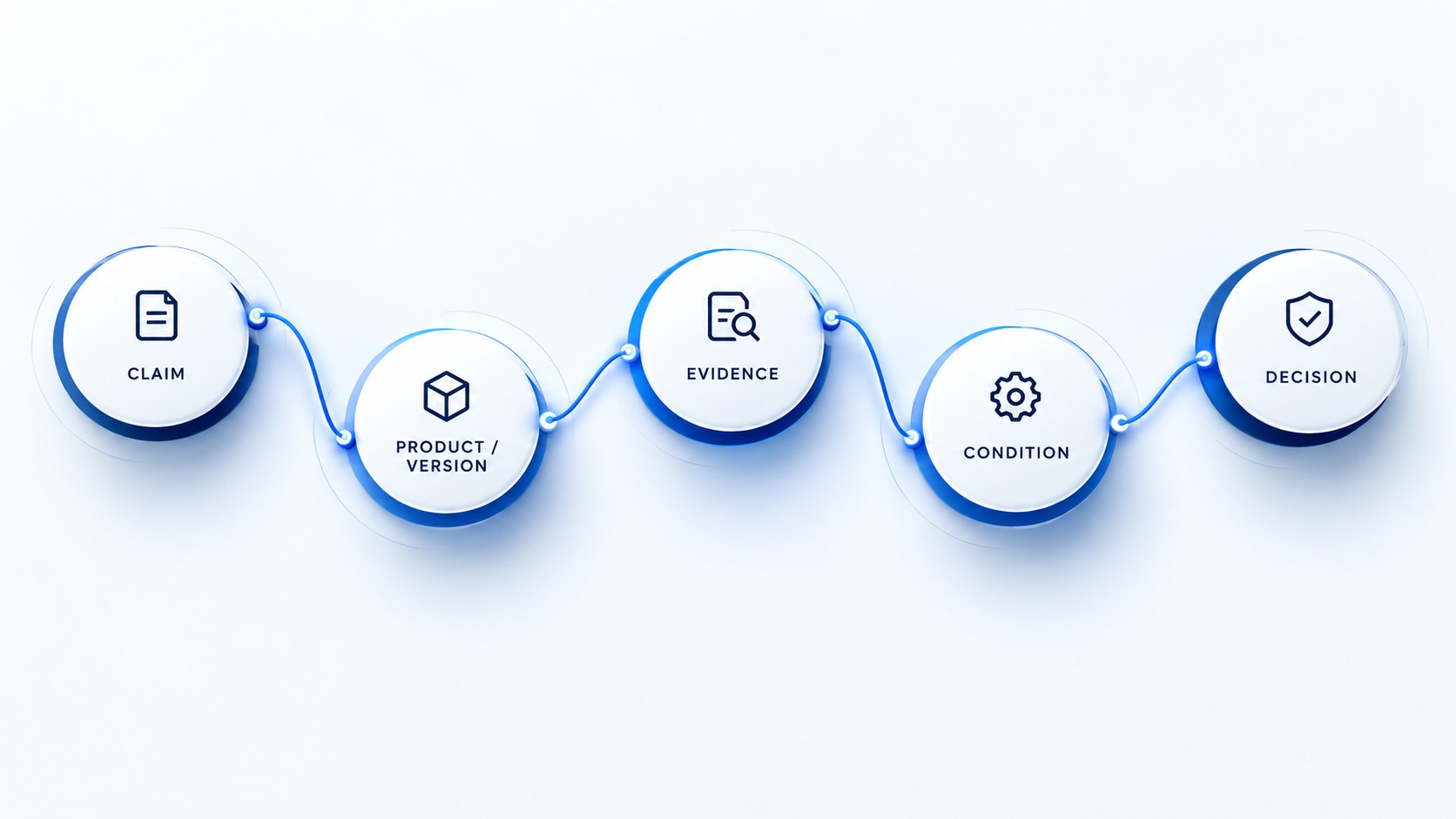
From claim to procurement decision.
Supplier claim
Define the exact capability, obligation or support statement being relied upon.
Product / version
Bind the claim to the exact product, module, component, build, function and version.
Evidence
Record source, scope, date, validation context and other evidence relevant to the decision.
Gap / condition
Keep missing, conditional or stale evidence visible and assign follow-up ownership.
Procurement decision
Route the result to evidence acceptance, conditions, remediation, escalation or a decision hold.
Revalidation
Revisit the evidence when the product, version, supplier commitment or decision context changes.
Procurement decision support
Structure the evidence request around the decision the business must make.
Questions for the supplier
- Which exact product, module, component or service is covered?
- Which version or build contains the capability?
- Which cryptographic or product-security function is supported?
- What documentation, validation, test or lifecycle evidence supports the statement?
- What dependencies, conditions or roadmap assumptions remain?
Questions for the enterprise
- What evidence is mandatory before evaluation, procurement or release?
- Which missing evidence can be remediated after a conditional decision?
- Which gaps require legal, security or architecture escalation?
- What should be written into the contract or RFP?
- What change would require the evidence to be revalidated?
Missing evidence & conditions
Unresolved evidence should remain an explicit decision state.
Evidence gaps can lead to a request for additional documentation, a pilot or test requirement, a contractual commitment, a conditional acceptance, remediation ownership or a decision hold. The important control is that the missing evidence remains visible and linked to the downstream decision rather than being interpreted as proof that the capability exists—or does not exist.
Who is responsible for obtaining or validating the missing information?
Does the gap block the decision, change the conditions or merely require follow-up?
Which unresolved issue belongs with architecture, security, legal, compliance or executive authority?
Which product, version, supplier or contractual change requires the record to be reviewed?
Relevant Strategic Verity research
Supplier evidence appears in both research programmes.
POST-QUANTUM ENTERPRISE READINESS 2027
Vendor Capability Matrix, Procurement / RFP Questionnaire, Technology Decision Matrix and Evidence Remediation Register support function- and version-specific supplier evidence for cryptographic migration decisions.
CYBER RESILIENCE ACT ENTERPRISE READINESS 2026–2027
Component Evidence Register, Supplier CRA Evidence Questionnaire and technical-documentation/readiness methods support traceable supplier and component evidence for product-level CRA readiness.
Next step
Evaluate the report that matches your supplier evidence problem.
Review the research structure and methodology, then request product or corporate licensing information.