
Decision area · Migration prioritization
Prioritise action without collapsing risk, urgency and execution readiness into one score.
Enterprise migration programmes need a defensible sequence for investigation, preparation, remediation, evidence collection, controlled hold and transition. The decision problem is not simply “what is risky?” but “what should happen next, and why?”
The enterprise decision problem
Different systems can be urgent for different reasons.
A portfolio may contain systems with long-lived sensitive data, quantum-vulnerable cryptography, critical business dependencies, weak supplier evidence, limited change windows or technology paths that are not yet sufficiently evidenced for production evaluation. A single risk score hides these differences.
Leadership instead needs to see which systems require immediate investigation, which need architecture or procurement work, which are ready for pilot or evaluation, which are blocked by evidence, and which can remain under controlled observation.
Why prioritisation fails
Common failure modes create false sequencing.
Exposure is treated as readiness
A system can have significant cryptographic exposure while the organisation still lacks the evidence, architecture or supplier support needed for responsible transition work.
Urgency becomes “deploy now”
High action urgency can require inventory closure, evidence collection, architecture preparation or a pilot before a production migration is justified.
Unknowns disappear
Missing product, version, dependency or validation evidence must remain visible because it can block a reliable priority or technology decision.
Execution difficulty distorts risk
Operational complexity, change constraints and migration effort are separate from quantum exposure and should be managed as a distinct execution dimension.
Dependencies are discovered too late
Supplier, protocol, PKI, trust-model and interoperability dependencies can change the feasible sequence even when the business urgency is clear.
Portfolio summaries hide blockers
Management needs product- or system-level traceability so an aggregate status cannot erase a critical unresolved dependency.
Controlled prioritisation approach
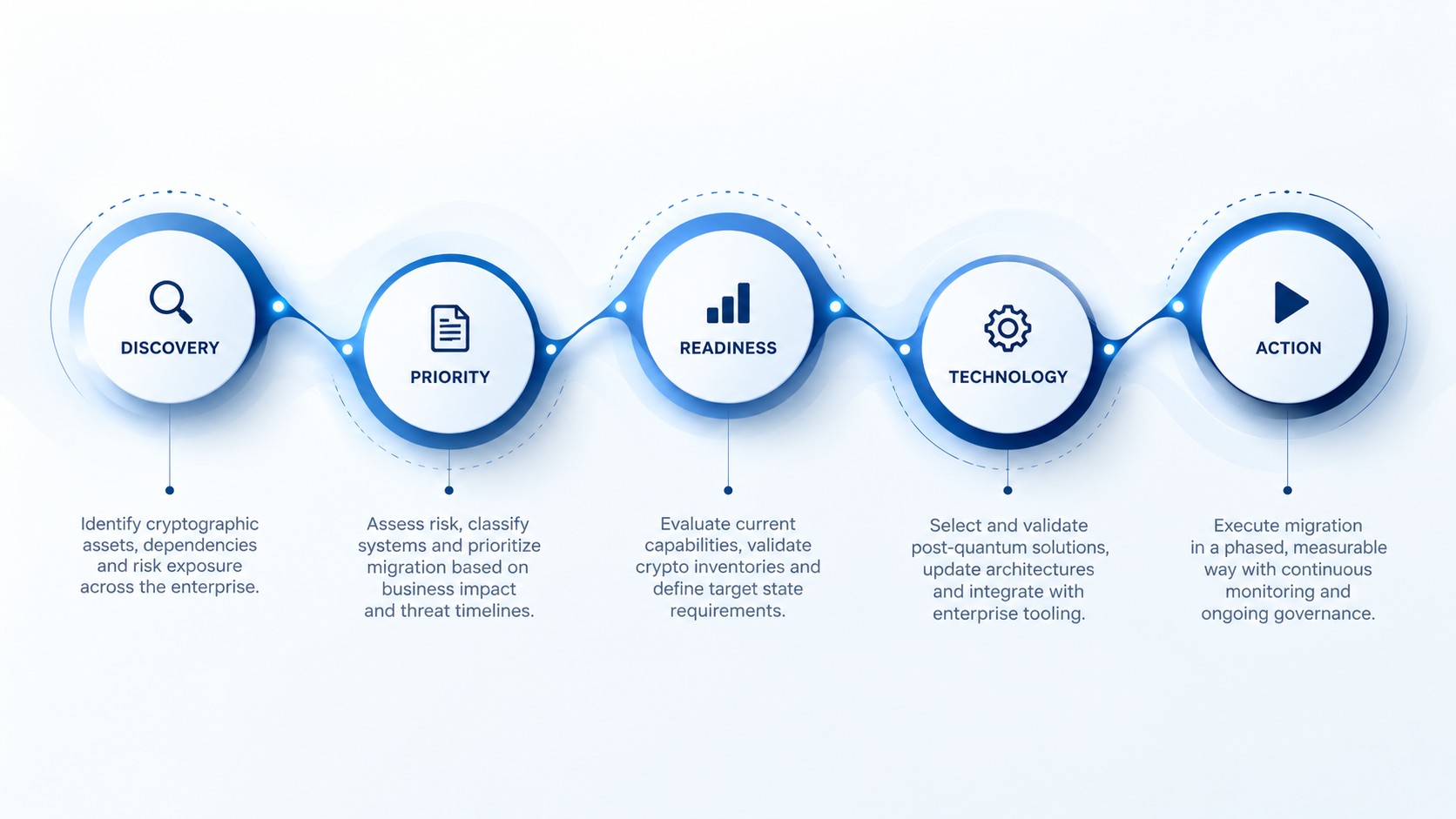
Separate the decision dimensions, then document the next managed state.
Risk & exposure
Establish the systems, data horizons and dependencies that create decision pressure.
Urgency
Separate action urgency from an assumption that production deployment is immediately justified.
Readiness
Assess whether the organisation has the evidence, ownership and execution capability to move.
Dependencies
Make supplier, architecture, validation and change constraints visible before sequencing.
Prioritised action
Document preparation, remediation, evidence collection, controlled hold or transition as the next managed state.
Decision inputs
What the enterprise must know before it can prioritise responsibly.
Which systems, protocols, cryptographic functions and dependencies are actually in scope?
How long must confidentiality remain meaningful, and what business or operational consequence is attached to the system?
Are ownership, architecture, inventory, test capability, governance and change capacity sufficient for the contemplated next step?
Which product, module, version, protocol, trust and validation facts are confirmed, conditional or still unknown?
What enterprise teams can establish
A management-ready action sequence with visible conditions.
For programme leadership
- Which systems need evidence work first.
- Which priorities are final versus provisional.
- Where readiness is lagging behind urgency.
- Which dependencies block evaluation or transition.
- Which actions belong in preparation, remediation, pilot or later transition.
For executive review
- Why a system was prioritised.
- Which evidence supports the decision.
- Who owns the next action.
- Which conditions prevent a stronger conclusion.
- What event should trigger revalidation.
Relevant Strategic Verity research
POST-QUANTUM ENTERPRISE READINESS 2027
The report contains integrated decision instruments for cryptographic exposure, HNDL, migration priority, enterprise readiness, the PQC Decision Gap™, technology decisions, supplier evidence, crypto agility, transition patterns, migration execution risk, remediation and decision logging.
For prioritisation work, the relevant chain includes Cryptographic Exposure, HNDL Exposure, System Migration Priority, Enterprise Readiness, Decision Gap, First-90-Days Executive Action, Transition Pattern and Migration Execution Risk methods.
CISO, CIO, Enterprise Architecture, Security Architecture, Cryptography/PKI, programme leadership, Risk and executive governance.
Management output
A documented priority and action state with evidence gaps, accountable ownership, dependencies and revalidation conditions.
Related decision areas